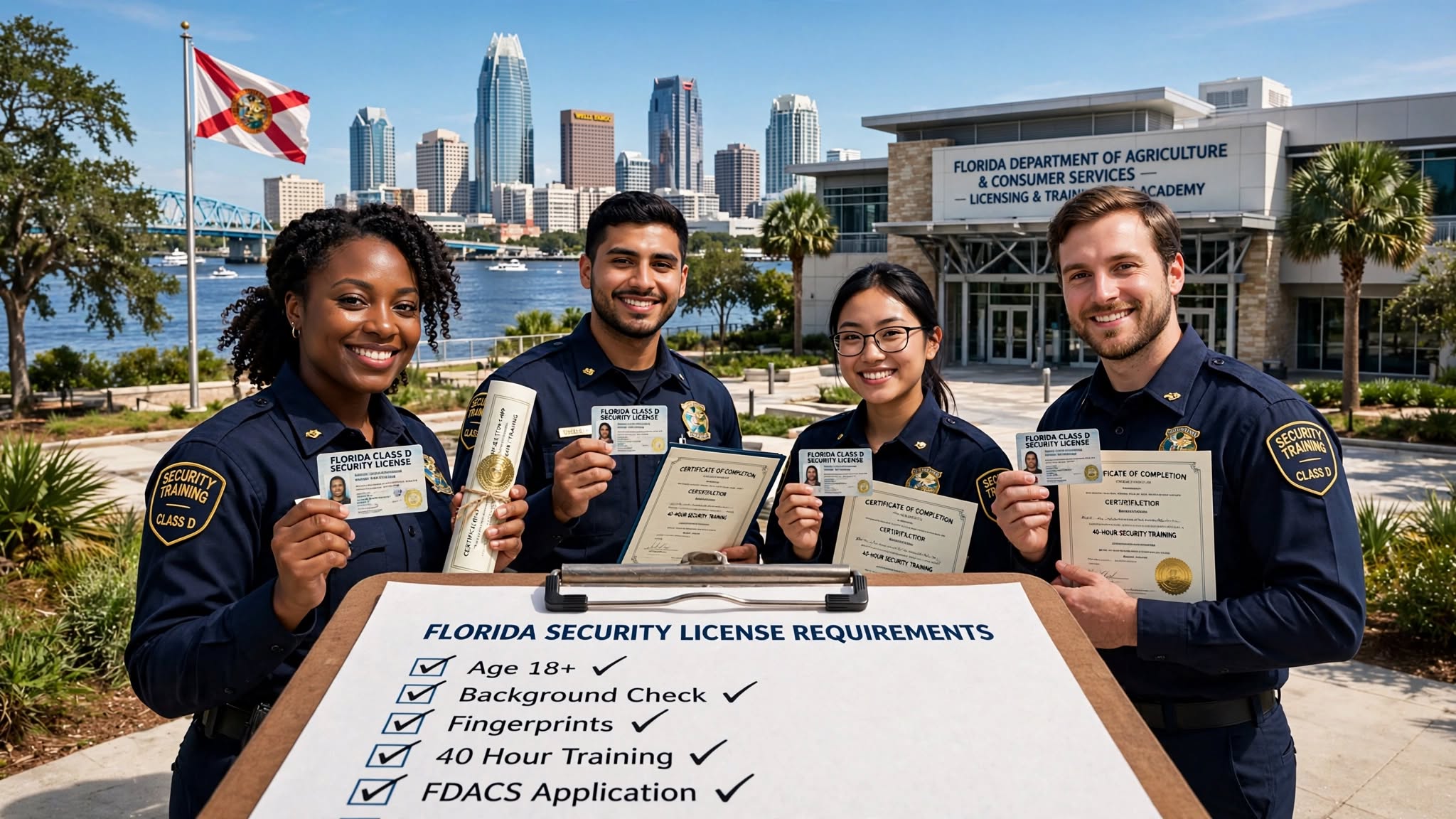
Entering the private security sector in Northeast Florida offers a direct pathway to dependable employment, steady career progression, and varied post assignments. Jacksonville serves as a bustling economic engine driven by busy maritime freight terminals at JAXPORT, sprawling corporate office complexes, logistics corridors, and gated residential communities. Because private security officers occupy positions of public trust, the State of Florida enforces rigorous qualification standards before granting the authority to work.
Understanding the baseline legal prerequisites established by state authorities ensures that prospective officers across Duval County prepare their documentation correctly, avoid application rejections, and launch their protective careers without unnecessary delays.
Essential Florida Security License Requirements Every Jacksonville Applicant Must Meet
Private security licensing throughout the state is governed by Chapter 493 of the Florida Statutes and administered by the Florida Department of Agriculture and Consumer Services (FDACS) Division of Licensing. Whether your goal is to work unarmed on a Class D license or upgrade to an armed Class G license, the state enforces clear eligibility benchmarks that every candidate must satisfy.
Age and Citizenship Standards
Florida establishes strict baseline standards regarding age and residency to ensure candidates can legally perform security duties within the state.
Minimum Age Requirements
- Unarmed Security (Class D): You must be at least 18 years of age at the time of application.
- Armed Security (Class G): You must be at least 21 years of age to apply for the statewide firearm license, matching state and federal handgun purchase thresholds.
Legal Residency and Work Authorization
Every applicant must provide verified proof of legal presence. Qualified candidates include:
- United States citizens.
- Lawful permanent resident aliens holding an active green card.
- Foreign nationals who have received official employment authorization from United States Citizenship and Immigration Services.
Candidates must also hold a valid Social Security number and provide documentation verifying their primary residential address.
Criminal Background and Moral Character Standards
Because security officers are entrusted with protecting people, proprietary facilities, and high-value cargo, FDACS requires complete criminal history vetting.
Electronic Lives can Fingerprint Clearance
All applicants must undergo biometric fingerprinting through an authorized Livescan service. These digital prints are cross-referenced across databases maintained by the Florida Department of Law Enforcement and the Federal Bureau of Investigation.
Statutory Disqualifications Under Florida Chapter 493
An application will be delayed, reviewed, or denied if the candidate has certain criminal marks on their record:
- Felony Convictions: Any felony conviction in Florida, another state, or under federal law creates an automatic disqualification unless civil rights have been formally restored and a mandatory 10-year statutory waiting period has elapsed.
- Crimes of Violence and Dishonesty: Having a history of convictions, or having adjudication withheld, for offenses such as burglary, armed robbery, assault, battery, theft, trespassing, or stalking demonstrates a lack of good moral character under Florida law.
- Active Legal Proceedings: Individuals currently subject to outstanding arrest warrants, open capias orders, or active participation in pre-trial intervention or deferred prosecution programs cannot be licensed until the legal matter is officially resolved.
- Controlled Substance and Alcohol History: Candidates with repeated substance abuse history or drug convictions under Florida Chapter 893 within the preceding three-year window must demonstrate certified completion of an approved rehabilitation program along with supporting professional character references.
Mandatory Classroom Training Requirements
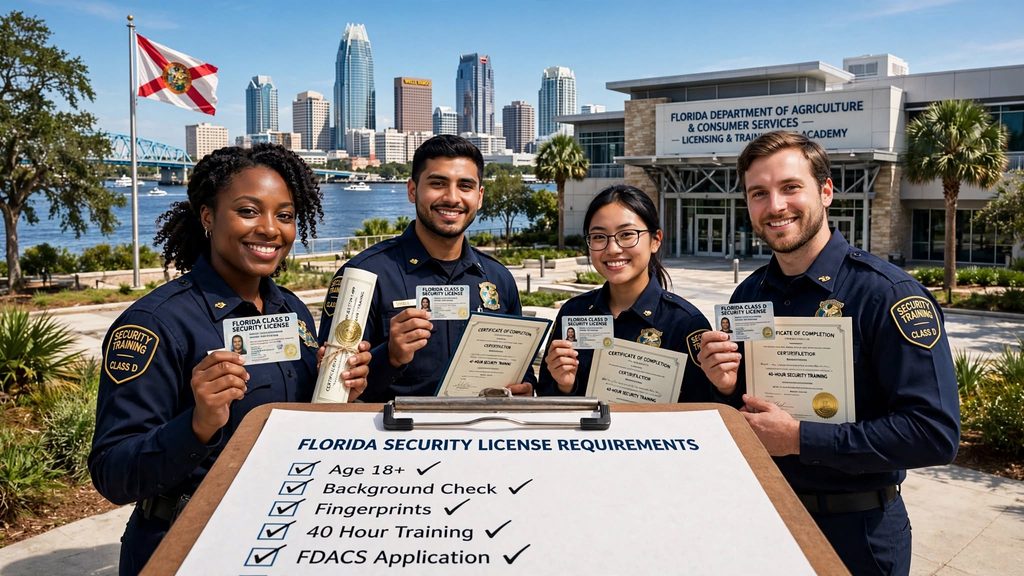
Florida does not allow uncertified individuals to perform private security services. Completing state-approved training at an accredited academy is mandatory before an application is approved.
The 40-Hour Class D Unarmed Course
Prospective unarmed officers must successfully complete 40 hours of professional instruction at a security school holding an active Class DS license issued by FDACS. This curriculum covers:
- Florida Chapter 493 legal statutes, lawful detention boundaries, and citizen’s arrest limits.
- The objective use-of-force continuum and non-lethal defense boundaries.
- Practical verbal de-escalation, conflict resolution, and spatial management.
- Emergency life safety fundamentals, automated external defibrillator usage, and facility evacuation protocols.
- Professional report writing, shift documentation, and field observation tactics.
Upon finishing the course and passing the written final examination, the academy provides the student with an official Certificate of Completion (Form FDACS-16103).
The 28-Hour Class G Armed Training Course
For personnel carrying a firearm on duty, Florida requires 28 hours of specialized instruction led by a licensed Class K firearms instructor. This training covers:
- Florida Chapter 776 governing the justifiable use of deadly force.
- Safe firearm mechanics, tactical retention holsters, and weapon handling.
- Live-fire marksmanship qualification on state-approved targets, firing 144 rounds under timed conditions.
State Application Documentation and Administrative Fees
Submitting an application requires assembling specific paperwork and remitting state processing fees to the Division of Licensing.
Required Submission Components
- A fully completed, signed, and notarized application form (Form FDACS-16007 for Class D).
- An original Certificate of Completion from an accredited Class DS training school.
- Your Livescan fingerprint confirmation containing your Transaction Control Number.
- A passport-style color photograph meeting state specifications (2 inches by 2 inches, taken within the past six months against a plain white background).
- Proof of citizenship, naturalization, or work authorization if born outside the United States.
Licensing and Fingerprint Fees
Applicants must pay the state application fee alongside the background screening charge. The standard Class D license fee covers a two-year licensing credential, with separate processing fees designated for state and federal fingerprint checks. These fees can be paid online via debit or credit card, or by cashier’s check or money order when filing by mail.
Fast-Tracking Your Employment: The 90-Day Temporary Certificate
One of the most practical provisions of Florida security regulations is the temporary license pathway.
Under Florida Statute 493.6303(4), once you complete your 40-hour training course, submit your biometric fingerprints, and file your complete application with FDACS, you or your employing licensed Class B security agency can access a 90-day temporary Class D security certificate. This legal authorization allows you to accept an assignment, complete site onboarding, and work billable security shifts throughout Jacksonville while the state processes your permanent card.
Meeting the Standard for Jacksonville Protective Services
Meeting Florida security license requirements is a structured, achievable process. By confirming your personal eligibility, completing accredited 40-hour training at a licensed academy, and submitting clear fingerprints, you satisfy every state mandate. With your credentials in hand, you can pursue rewarding security opportunities across Jacksonville’s commercial, industrial, and residential sectors.