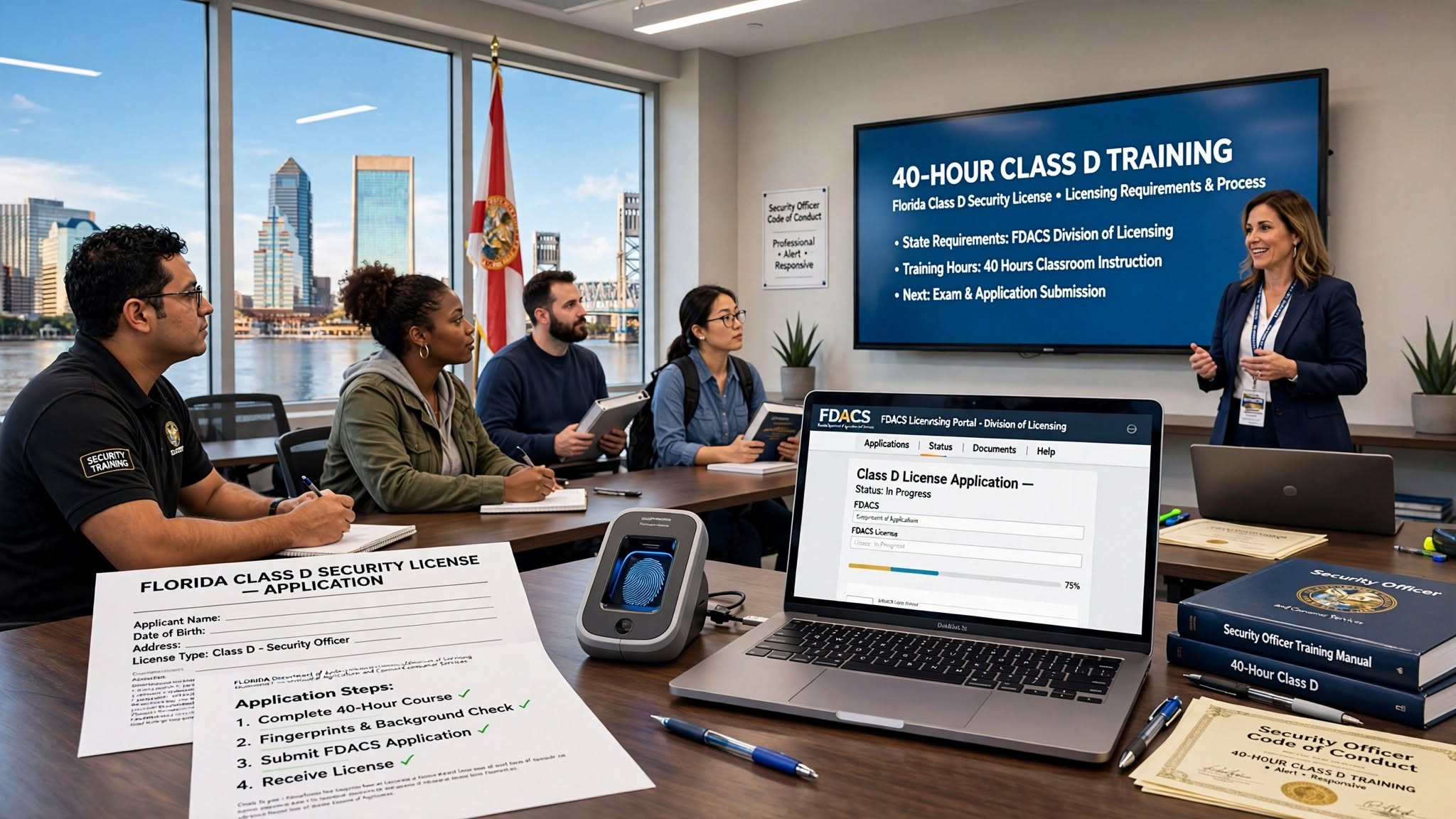
Starting a career as an unarmed security officer in Northeast Florida requires passing state-mandated educational hurdles and administrative reviews. Commercial developments, healthcare facilities, and logistics centers throughout Duval County seek disciplined, credentialed individuals to protect assets and ensure site safety. The path to securing these opportunities begins with professional classroom training followed by formal state licensing.
This detailed guide outlines the 40-hour training requirements and application steps necessary to earn your Florida Class D security officer license and transition smoothly into the Jacksonville job market.
Understanding the 40-Hour Class D Training Mandate
Under Florida Statute Chapter 493, the Florida Department of Agriculture and Consumer Services (FDACS) Division of Licensing requires all unarmed security officers to complete 40 hours of formal instruction. This coursework must be completed at a licensed security school holding an active Class DS credential.
The training ensures that every guard working in public or private spaces understands statutory legal limits, emergency life safety procedures, and effective dispute resolution tactics.
Core Modules of the 40-Hour Curriculum
The state curriculum is structured into specific operational disciplines to build a well-rounded foundation:
Florida Legal Statutes and Civil Liability
Recruits learn the precise legal authority granted to private security officers versus sworn law enforcement. Instructors cover:
- Florida Chapter 493 rules governing security operations and licensing maintenance.
- Criminal trespass definitions and proper execution of formal trespass notices.
- Limits on citizen detentions, retail theft stops, and search restrictions.
- Civil liability risks, avoiding false imprisonment accusations, and protecting employer assets.
Proportional Response and the Use-of-Force Continuum
Understanding proportional response prevents unnecessary confrontations. Officers study the legal use-of-force continuum, learning to resolve issues through presence and voice before considering physical restraint or defensive tactics.
Practical Verbal De-Escalation and Spatial Awareness
Because communication solves the majority of workplace disputes, substantial classroom time focuses on active listening, keeping a defensive reactionary gap, and adopting non-threatening body language to calm hostile visitors.
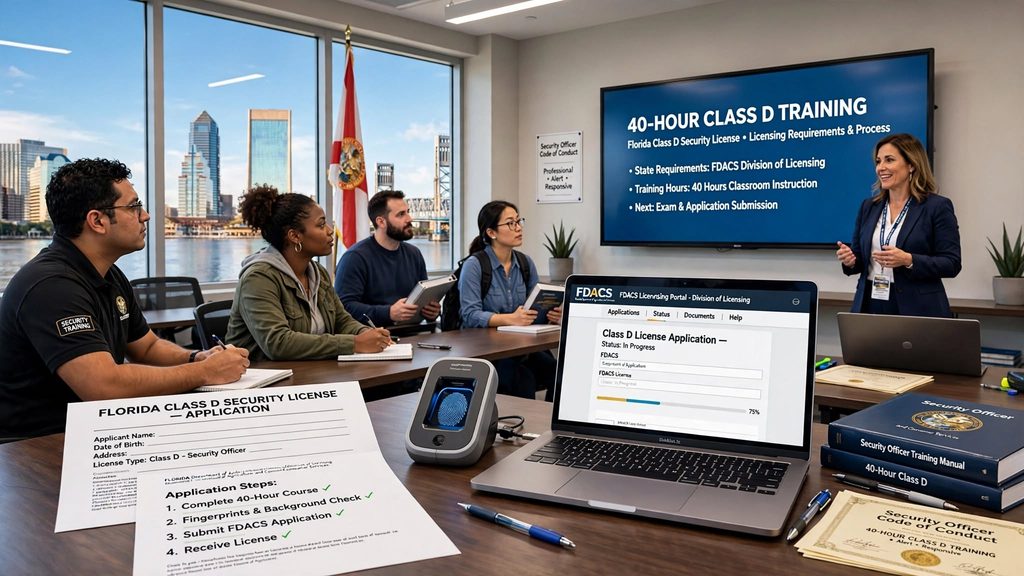
Access Control, Patrol Methods, and Hazard Scanning
Trainees study standard operating procedures for vehicle gatehouses, commercial lobby check-ins, and logistics yard checkpoints. Instruction also includes foot patrol techniques, identifying facility security flaws, and spotting unlit exterior areas.
Shift Reporting and Incident Documentation
Students practice keeping accurate daily activity reports and writing formal incident reports. Instructors emphasize recording factual observations, exact timestamps, and witness statements rather than subjective opinions.
Emergency Response and Life Safety
Courses include instruction on basic first aid, automated external defibrillator operation, fire watch guidelines, portable extinguisher use, and building evacuation coordination.
Passing the Written State Examination
At the end of the 40-hour curriculum, trainees must take a comprehensive written exam administered by the training school.
The exam tests knowledge of Florida security statutes, ethical standards, report writing, and emergency protocols. Achieving a passing score earns the student an official Certificate of Completion (Form FDACS-16103), which serves as mandatory proof of training for the state application packet.
Navigating the Florida Class D Application Steps
Once classroom training is finished, candidates move to the administrative phase of licensure.
Step 1: Complete Livescan Fingerprint Screening
Florida mandates criminal background screening through both the Florida Department of Law Enforcement and the FBI. Applicants must visit an approved Livescan service provider to submit electronic fingerprints.
Upon completion, you receive a receipt containing your Transaction Control Number. This tracking code must be included with your application to link your background results to your licensing file.
Step 2: Assemble Required Application Documentation
Ensure your submission packet contains all required materials to avoid processing delays:
- The completed Class D Security Officer Application (Form FDACS-16007), signed and properly notarized.
- The original Certificate of Completion from your accredited Class DS training academy.
- The Livescan fingerprint confirmation receipt showing your Transaction Control Number.
- A passport-style color photograph measuring two inches by two inches, taken within the last six months.
- Proof of citizenship, permanent resident alien status, or federal work authorization.
- Payment for all mandatory state licensing and fingerprint processing fees.
Step 3: Submit Your Application to FDACS
Applicants can submit their licensing paperwork through two channels:
- Online Portal: Submitting through the official FDACS online portal allows you to upload digital documents, track application progress in real time, and pay fees via debit or credit card.
- Mail Submission: You can mail your physical, notarized documents alongside a cashier’s check or money order directly to the Division of Licensing in Tallahassee.
Working Under a 90-Day Temporary Certificate
Florida law provides a legal pathway allowing qualified candidates to start earning an income before their physical card arrives.
Under Florida Statute 493.6303(4), once your completed application, training certificate, and fingerprint verification are received by FDACS, you or your prospective security employer can obtain a 90-day temporary Class D security license certificate. This authorization allows you to accept an assignment, complete company onboarding, and work active security shifts throughout Jacksonville while the state finalizes background reviews.
Launch Your Security Career in Duval County
Completing the 40-hour Class D course and submitting your state application equips you with the necessary credentials to enter Northeast Florida’s growing security industry. With training completed and paperwork filed, you can pursue stable, rewarding roles across Jacksonville’s commercial centers, logistics distribution networks, and residential communities.