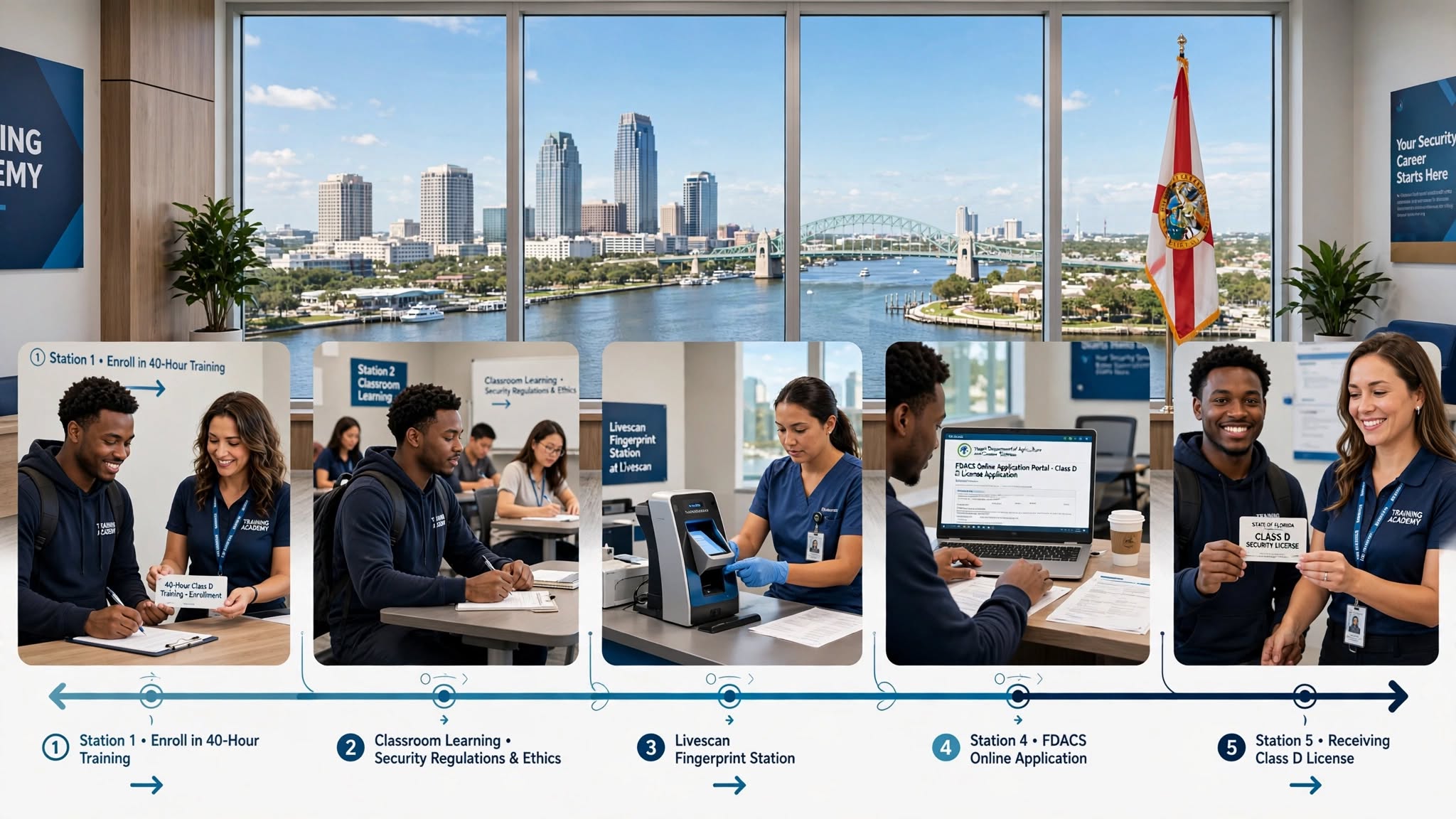
Securing a career in Florida’s protective services starts with obtaining the foundational state credential. With Northeast Florida experiencing ongoing commercial development, high-volume shipping operations at JAXPORT, and active business hubs throughout Duval County, qualified unarmed security officers are in constant demand. Working legally in this sector requires understanding state regulations and following proper procedures.
This guide is general Florida licensing information, not confirmation of a Blue Training Academy Florida Class D course. Review FDACS requirements and confirm the school’s license and course availability before paying.
How to Get a Class D License in Florida: The Step-by-Step Jacksonville Guide
Florida private security licensing is administered by FDACS under Chapter 493. A training certificate is a separate document from a state license.
Use the current FDACS instructions to prepare your application. Approval and processing time depend on the regulator’s review.
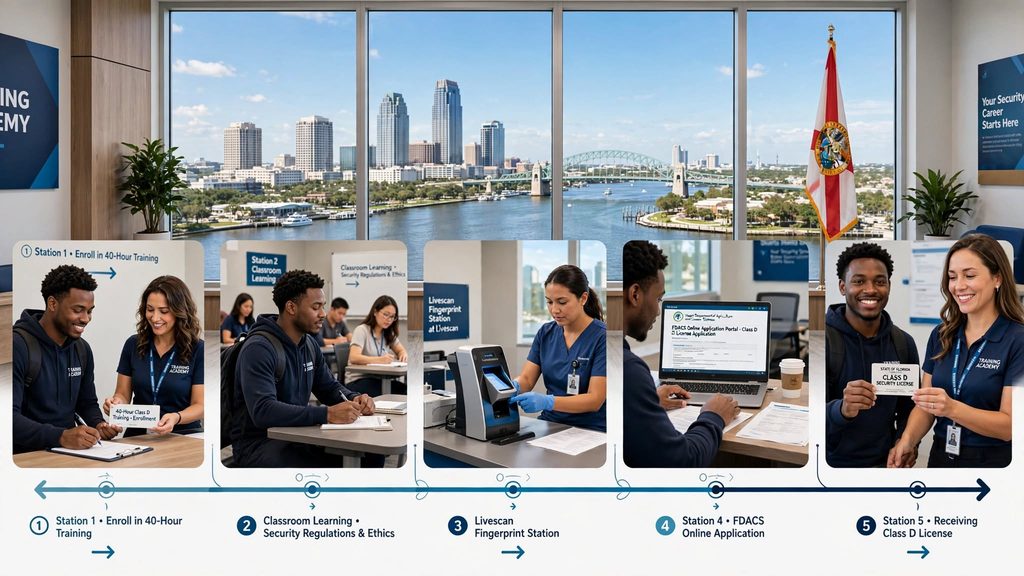
Step 1: Confirm Your Basic Eligibility
Before enrolling in courses or paying processing fees, verify that you meet the minimum qualifications established by Florida law:
- Be at least 18 years of age.
- Possess United States citizenship, permanent resident alien status, or official work authorization from federal immigration authorities.
- Have a valid Social Security number.
- Possess a clean criminal history free of disqualifying felony convictions or active warrants.
- Demonstrate good moral character, with no recent convictions involving violent crimes, theft, or substance abuse.
Step 2: Complete the 40-Hour Class D Training Course
FDACS generally requires proof of at least 40 hours of training at a licensed school or training facility for Class D applicants, with specified training or experience exceptions. Review the current requirements and exceptions for your circumstances.
Core Subjects Covered in the 40-Hour Curriculum
- Florida Legal Statutes: Learning Chapter 493, citizen detention limits, trespassing rules, and property jurisdiction boundaries.
- The Use-of-Force Continuum: Understanding proportional response, legal liability, and defensive positioning.
- Verbal De-Escalation: Mastering active listening, spatial awareness, and non-violent conflict resolution.
- Observation and Patrol Tactics: Implementing effective foot patrols, vehicle sweeps, checkpoint monitoring, and hazard detection.
- Report Writing: Drafting clear daily activity reports and objective incident reports detailing timestamps, locations, and factual descriptions.
- Emergency Life Safety: Training in basic first aid, CPR procedures, automated external defibrillator usage, and emergency building evacuation plans.
Questions to Ask About Class Schedules
- Daytime study: Ask the licensed school which daytime sessions are actually scheduled and how attendance is recorded.
- Evening study: Confirm whether evening instruction is offered and the actual dates before enrolling.
- Weekend study: Ask about available weekend dates and how the full required training is delivered.
After finishing all classroom hours and passing the written examination, you will receive an official Certificate of Completion (Form FDACS-16103) from your training academy.
Step 3: Complete Electronic Livescan Fingerprinting
Florida mandates state and national criminal history reviews for every private security applicant.
Follow FDACS fingerprint instructions for your chosen application route, including any required payment and submission steps.
Confirm fingerprint services directly with the provider; do not assume they are included in tuition or offered at the training site.
Step 4: Assemble and Submit Your FDACS Application Packet
With your training certificate and fingerprint receipt in hand, prepare your formal submission packet for the Division of Licensing.
Required Application Components
- Application Form: A fully completed, signed, and notarized Class D Security Officer Application (Form FDACS-16007).
- Proof of Training: Your original Certificate of Completion issued by a licensed Class DS school.
- Fingerprint Confirmation: Your Livescan receipt displaying the Transaction Control Number.
- Passport-Style Photo: One recent color photograph (2 inches by 2 inches) taken against a plain white background within the last six months.
- Proof of Legal Status: A copy of your birth certificate, passport, or permanent resident card if applicable.
- State Licensing Fees: Payment covering the initial two-year Class D license fee and state fingerprint processing fees.
Submission Methods
- Submission options: FDACS lists online, in-person, and mail routes. Review the official application instructions for the route you choose.
- Mail Submission: You can also mail your physical, notarized paperwork alongside a cashier’s check or money order directly to the Division of Licensing in Tallahassee.
Step 5: Confirm Authorization Before Starting Work
Ask FDACS and your licensed employer to confirm your status before beginning a security assignment.
The cited section 493.6303(4) addresses Class D training. It does not establish the 90-day temporary certificate previously described here. Confirm your authorization to work directly with FDACS and your licensed employer before accepting a security assignment.
Launch Your Protective Career in Jacksonville
Course completion and an application submission are separate from the state’s licensing decision. For Blue Training Academy offerings, browse the current course catalog. Employers can use our team training guide and inquiry form to discuss available options.