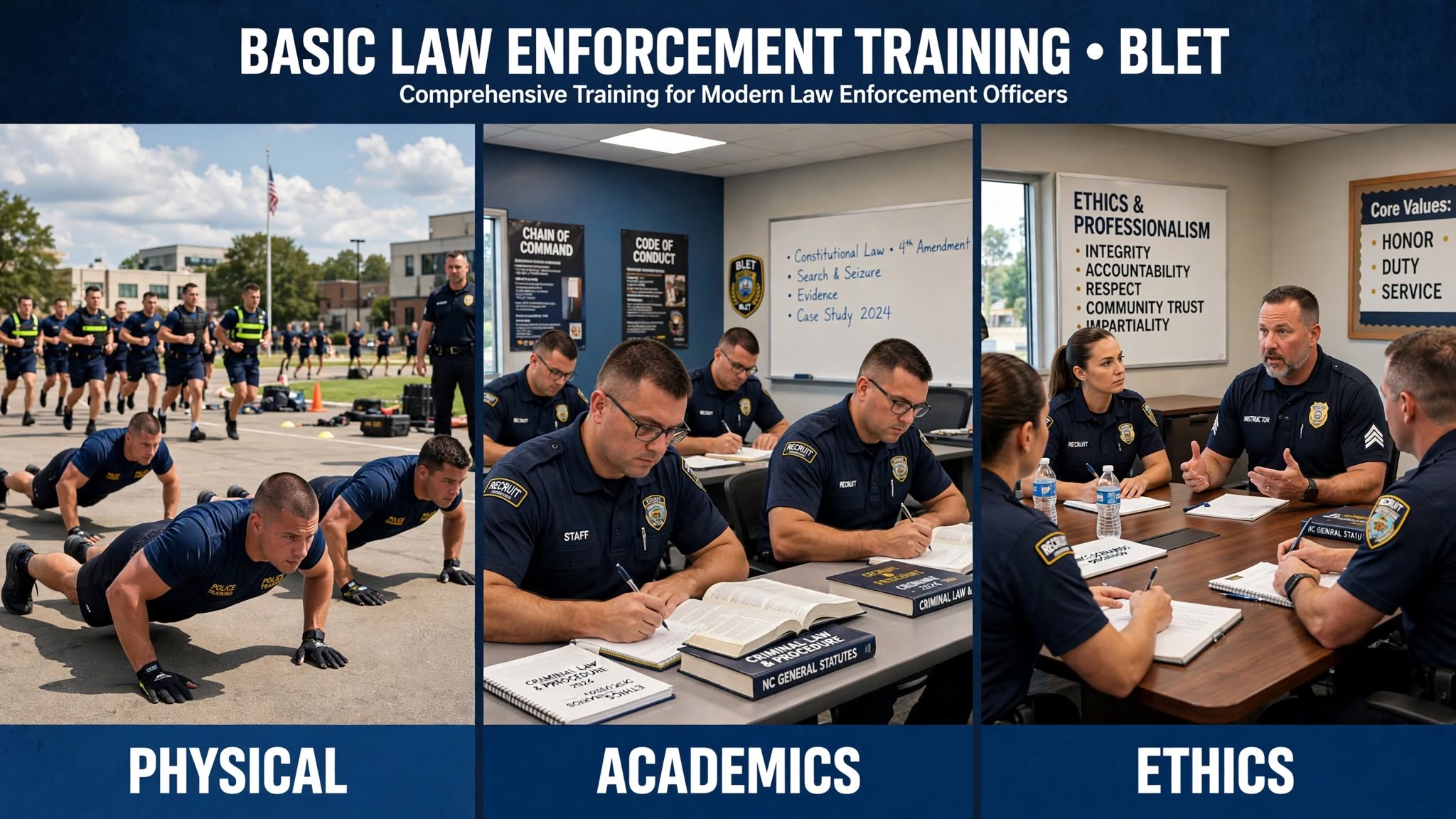
Entering a career in public safety and law enforcement demands far more than physical strength or an interest in community service. It requires discipline, acute legal judgment, and unwavering moral character. Every qualified peace officer begins with basic law enforcement training, where recruits transform from civilian applicants into capable, sworn personnel ready to protect their communities.
For aspiring officers, entering an academy without clear preparation often leads to unexpected academic stress or physical failure. Understanding the baseline expectations of the curriculum ensures candidates arrive mentally focused and physically conditioned to succeed.
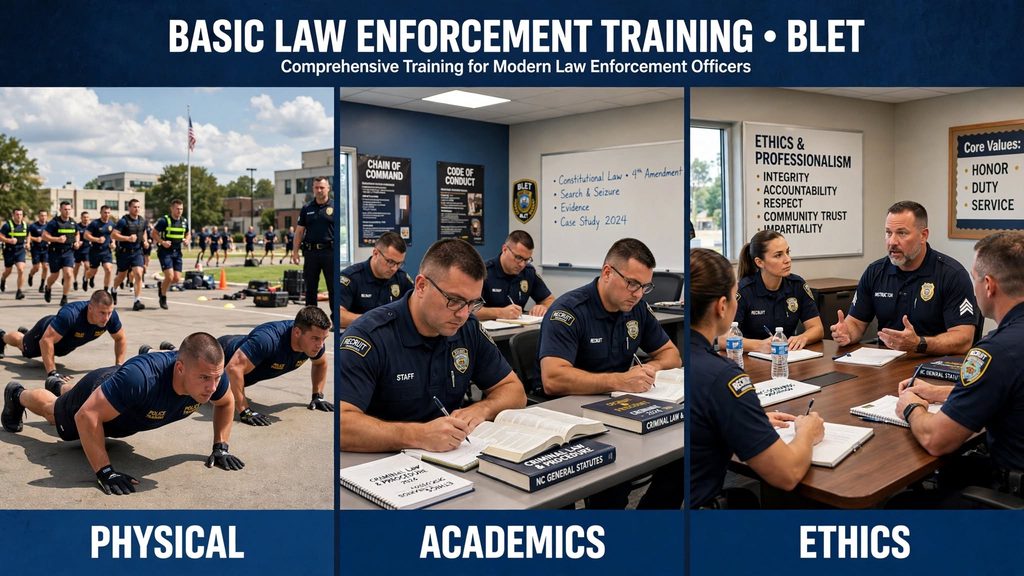
Blue Training Academy delivers comprehensive law enforcement and protective services instruction led by career tactical instructors and seasoned police veterans. By breaking down the training experience into its core pillars physical readiness, classroom academics, and professional ethics candidates can approach their coursework with complete confidence.
1. Physical Fitness and Conditioning Standards
Physical agility is not merely an entrance requirement; it is a vital survival tool in the field. Basic law enforcement training subjects recruits to rigorous daily calisthenics, functional strength conditioning, and aerobic conditioning designed to build cardiovascular endurance and physical resilience under stress.
- Standard Agility Assessments: Recruits must meet state-mandated physical efficiency battery standards, which typically evaluate vertical jump, timed push-ups, timed sit-ups, and a 1.5-mile run.
- Obstacle and Stress Courses: Beyond static gym workouts, academies implement obstacle runs that simulate foot pursuits, fence scaling, stair climbs, and dragging simulated casualties or suspects under time constraints.
- Defensive Tactics Preparation: Physical fitness directly supports defensive tactics, including weapon retention, ground defense, and subject control mechanics. Recruits must maintain the physical stamina needed to defend themselves during prolonged physical confrontations.
2. Rigorous Academic Curriculum and Legal Foundations
The modern police recruit spends hundreds of hours in a classroom setting. Today’s public safety environment demands that officers function as analytical legal practitioners who make split-second constitutional decisions under severe pressure.
- Constitutional and State Criminal Law: Recruits analyze Fourth Amendment search-and-seizure standards, Fifth Amendment protections against self-incrimination, and Fourteenth Amendment due process requirements. Mastery of state penal codes, arrest procedures, and statutory elements of crimes is verified through weekly written examinations.
- Rules of Evidence and Crime Scene Preservation: Academies provide in-depth instruction on maintaining strict chain of custody, documenting forensic evidence, lifting latent prints, and legally impounding property.
- Traffic and Motor Vehicle Enforcement: Classroom instruction covers statutory traffic codes, collision investigations, high-visibility vehicle stops, and the standardized legal protocols for detecting impaired drivers.
- Written Communication and Courtroom Testimony: An officer’s case is only as solid as their paperwork. Recruits learn to write objective, chronological incident reports that withstand intense cross-examination by defense attorneys in court.
3. Practical Applied Skills and Tactical Labs
Academics provide the legal theory, but practical laboratory sessions teach recruits how to apply those principles in dynamic, uncontrolled real-world environments.
- Firearms Safety and Marksmanship: Recruits receive intensive mechanical instruction covering the four universal firearm safety rules, rapid holster draws, clearing weapon stoppages, low-light shooting, and passing state-mandated qualification courses of fire.
- Emergency Vehicle Operations Course (EVOC): Precision driving instruction teaches recruits pursuit driving dynamics, high-speed braking, skid control, and the critical legal standards for when an emergency pursuit must be terminated.
- Scenario-Based De-Escalation Training: Utilizing realistic role-playing scenarios with specialized training weapons, students practice verbal tactical communications, spatial awareness, and non-lethal conflict resolution before escalating force.
- Tactical Emergency Casualty Care (TECC): Recruits learn to treat life-threatening injuries under fire, mastering tourniquet application, airway clearance, chest seals, and mass-casualty triage protocols.
4. Uncompromising Ethical Standards and Professional Conduct
Physical strength and academic knowledge are useless without an ironclad ethical compass. Law enforcement officers carry extraordinary public trust and legal authority, including the power to deprive individuals of their liberty. Academies hold recruits to the highest ethical and moral standards from day one.
- Integrity and the Code of Ethics: Candidates explore the Law Enforcement Code of Ethics, examining the devastating consequences of perjury, evidence tampering, civil rights violations, and abuse of police powers.
- Implicit Bias and Impartial Policing: Professional training emphasizes treating every community member with dignity, respect, and constitutional fairness, regardless of race, background, or socioeconomic status.
- Accountability and Peer Intervention: Recruits study duty-to-intervene policies, learning the moral and legal responsibility to step in and stop excessive force or unethical conduct by fellow officers.
- Stress Management and Mental Resilience: Academies provide training on the psychological toll of police work, offering tools for cumulative stress management, peer support, and family wellness to ensure long-term career resilience.
5. Preparing Mentally and Physically Before Your First Day
Success in basic law enforcement training is determined months before the first academy inspection. Arriving prepared sets the foundation for high academic standing and leadership roles within the recruit class.
- Begin Conditioning Early: Do not wait for day one to start running. Build a consistent routine of aerobic running, bodyweight circuits, and mobility stretching at least twelve weeks prior to your start date.
- Develop Strong Study Habits: Treat academy academics like an intensive university program. Form study groups, utilize flashcards for statutory definitions, and dedicate uninterrupted evening hours to review daily lecture material.
- Embrace the Teambuilding Mindset: Basic training is not an individual competition. Instructors evaluate how recruits support struggling peers, communicate under duress, and function as a cohesive operational unit.
Launch Your Public Safety Career with Blue Training Academy
The journey toward earning a badge requires dedication, focus, and world-class instruction. Preparing for the physical, academic, and ethical demands of law enforcement ensures you do not just pass the academy; you graduate ready to protect and lead your community.
Blue Training Academy offers elite foundational programs, legal preparation modules, and advanced tactical courses designed to help recruits and protective specialists excel at every level of their training.