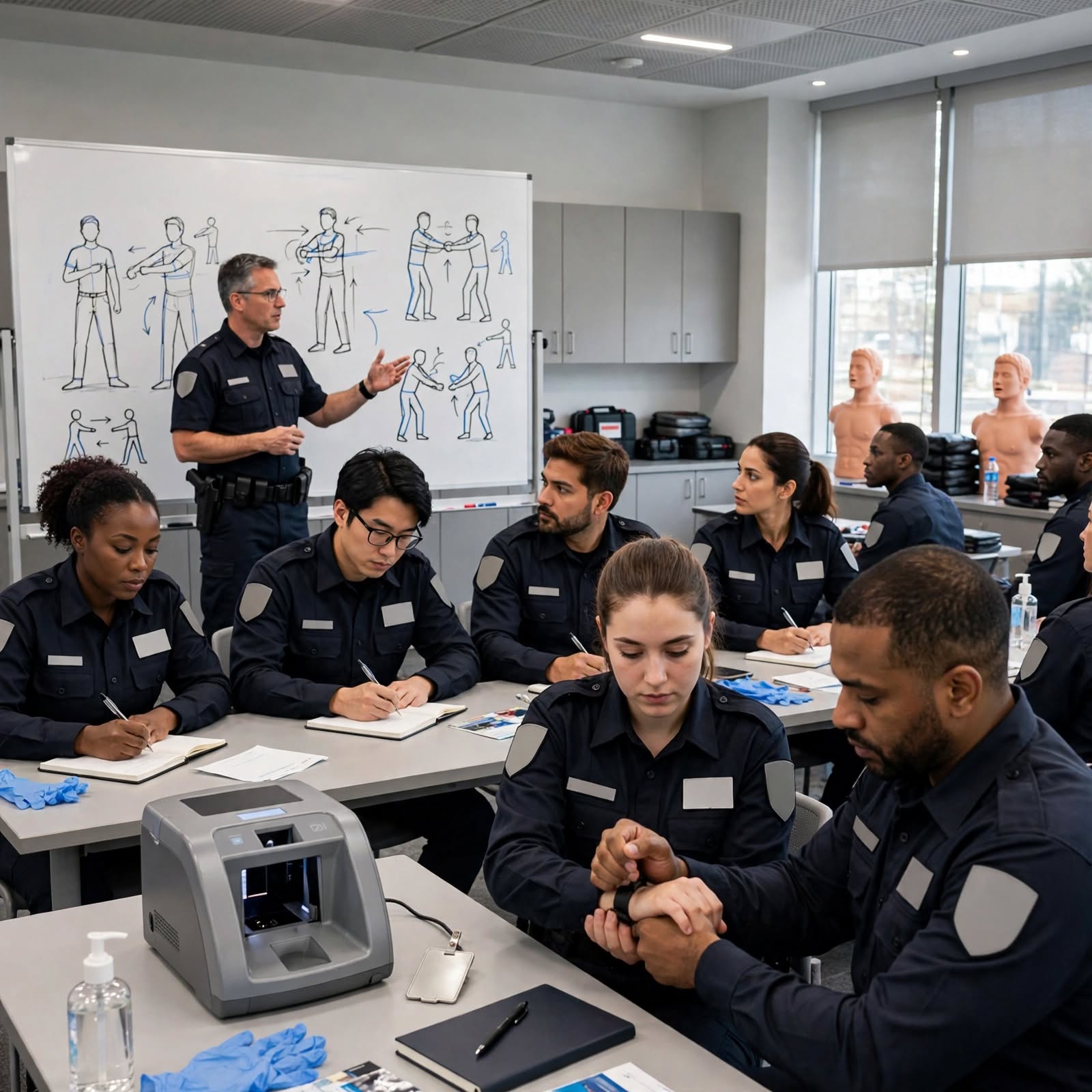
Launching or upgrading a career in private security requires more than simply applying for open guard positions. Modern security officers carry substantial responsibility, acting as the first line of defense for commercial facilities, residential complexes, industrial assets, and corporate personnel. Navigating this responsibility safely, lawfully, and effectively demands formal instruction backed by official state credentials.
Not all training programs offer the same caliber of instruction. Low-quality providers often deliver superficial overviews that leave graduates unprepared for the legal complexities and physical risks of active field duty. Choosing a certified, comprehensive program is the single most important decision an aspiring security professional can make.
Blue Training Academy delivers rigorous, state-approved instruction led by career tactical specialists, law enforcement veterans, and legal experts, ensuring students graduate fully prepared to excel on the job.
1. Official State Accreditation and Licensing Board Compliance
The foundational criterion for any private security program is full alignment with state regulatory standards. A completion certificate holds zero value if it does not satisfy the statutory curriculum hours mandated by state licensing boards.
- Verified Board Approval: Ensure the training facility is explicitly recognized and authorized by governing state agencies, such as the Tennessee Department of Commerce and Insurance (TDCI) or the Alabama Security Regulatory Board (ASRB).
- Seamless Application Processing: Accredited academies provide verified completion certificates and official course paperwork that state licensing bodies accept immediately, preventing costly application delays or rejections.
- Direct Path to Both Unarmed and Armed Endorsements: Quality institutions provide structured coursework that allows officers to fulfill mandatory foundational training before transitioning into state-approved armed security certification.
2. Experienced, Vetted Field Instructors
The quality of training depends heavily on the practical experience of the instructors leading the classroom. Security protocols cannot be mastered through memorized slide presentations alone; they require insight grounded in real-world application.
- Real-World Law Enforcement and Military Backgrounds: The best academies utilize instructors with decades of active experience in patrol operations, tactical response, criminal investigation, and military force protection.
- Practical Context Over Theory: Seasoned instructors share real-life case studies, explaining the practical nuances of de-escalating aggressive individuals, identifying dynamic threats, and navigating field confrontations.
- Continuous Instructor Certification: Credible training organizations ensure their instructors hold up-to-date state instructor credentials, advanced firearms certifications, and active instructor ratings in tactical medicine and defensive tactics.
3. In-Depth Legal and Constitutional Foundations
Private security officers are private citizens with specific statutory roles, not sworn police officers. A single mistake regarding an officer’s legal authority can result in personal criminal charges, license revocation, and multi-million-dollar lawsuits for property owners.
- Use-of-Force Statutes: A rigorous course breaks down statutory legal thresholds governing physical control, self-defense, defense of third parties, and the strict parameters surrounding the use of non-lethal or lethal force.
- Detention and Citizen’s Arrest Parameters: Instructors must teach the exact legal boundary separating lawful detention of retail or property offenders from unlawful restraint and false imprisonment.
- Search, Seizure, and Private Property Rights: Officers must understand how Fourth Amendment privacy protections apply on private property, how to conduct lawful consent searches, and how to preserve physical evidence for responding police agencies.
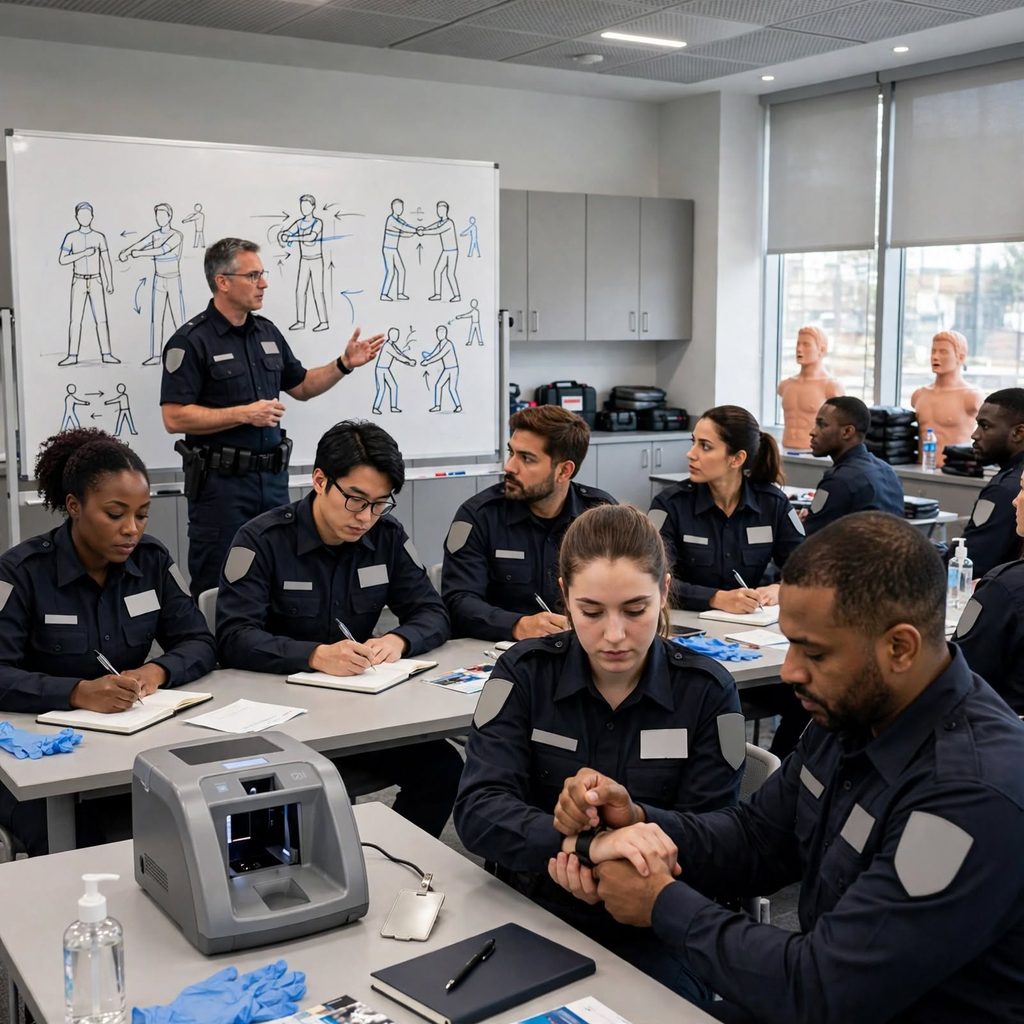
4. Hands-On Practical Defensive Tactics and Equipment Familiarization
True preparedness requires muscle memory, spatial discipline, and tactical motor skills developed through structured, supervised repetition.
- Verbal De-Escalation and Spatial Positioning: Officers should learn verbal conflict resolution tactics and interview stances designed to defuse volatile encounters while maintaining reaction time.
- Safe Subject Restraint and Handcuffing: Look for courses covering compliant and non-compliant handcuffing, wrist manipulation, and ground control mechanics that prioritize both officer safety and subject well-being.
- Weapon Retention Fundamentals: Any officer carrying defensive gear must understand the biomechanics of preventing a subject from grabbing, stripping, or deploying their equipment.
- Emergency Trauma First Aid: Leading curricula integrate certified training in cardiopulmonary resuscitation (CPR), automated external defibrillator (AED) usage, and Tactical Emergency Casualty Care (TECC) protocols, such as tourniquet placement and pressure dressings.
5. Professional Report Writing and Liability Documentation
An officer’s written documentation is an essential safeguard against legal liability. A comprehensive training program emphasizes clear administrative reporting alongside tactical field skills.
- Daily Activity Reports (DARs): Students learn to write objective, chronological shift summaries that provide facility managers with actionable operational insights.
- Incident and Use-of-Force Reporting: Trainees practice producing clear, factual documentation detailing property damage, trespass warnings, forced entries, or physical confrontations that stand up under judicial scrutiny in court.
- Radio and Emergency Dispatch Etiquette: Professional courses teach standard radio protocols, phonetic clarity, and concise reporting formats to ensure clear communication during active emergencies.
6. Reputation and Career Placement Support
An accredited academy should serve as a trusted bridge between qualification and long-term employment within the professional security industry.
- Industry Recognition: Reputable security firms, corporate security directors, and commercial property managers actively look for applicants certified through respected, established academies.
- Career Guidance and Networking: Dedicated training centers assist students with licensing navigation, state renewal processes, and direct connections to vetted security contractors and corporate employers.
- Commitment to Continuing Education: Look for organizations offering an extensive catalog of advanced classes—from executive protection and advanced firearms to specialized patrol supervision—supporting your career progression over time.
Build Your Foundation with Blue Training Academy
Choosing the right training partner defines the trajectory of your security career. Committing to professional, state-accredited instruction provides you with the skills, legal understanding, and practical confidence needed to stand out as an elite security officer.
Blue Training Academy delivers industry-leading curriculum standards, modern instructional methods, and dedicated instructor support to help students achieve official state licensing and reach their professional goals.