In high-stakes public safety environments, peace officers rarely have the luxury of time to evaluate options deliberately. Split-second choices made under intense physiological stress, sensory overload, and incomplete information carry life-or-death consequences for community members and officers alike.
Traditional training models that rely primarily on static lectures, textbook memorization, or predictable firing range drills provide the legal and mechanical framework, but they fall short of replicating the chaotic realities of field encounters. To bridge this divide, modern policing relies heavily on immersive scenario-based decision-making.
Blue Training Academy integrates realistic, scenario-driven instruction across its law enforcement and protective curriculum. By placing officers in controlled, dynamic simulations led by veteran tactical instructors, trainees develop the critical mental models, emotional discipline, and tactical fluency needed to protect lives and resolve crises lawfully.
1. Bridging the Gap Between Classroom Theory and Field Reality
Understanding constitutional law, agency policies, and use-of-force continuums on paper does not automatically translate into sound judgment when an individual reaches unexpectedly into a jacket during a nighttime contact.
- Contextualizing Legal Statutes: Scenario training forces officers to translate Fourth Amendment principles and state statutes into real-time physical boundaries, recognizing the exact threshold where an encounter transitions from a consensual talk to a reasonable suspicion stop.
- Breaking the Predictability Trap: Routine qualification drills teach mechanical proficiency under calm conditions, but suspects in the field do not stand still or await instructions. Unpredictable scenario actors challenge officers to adapt when initial plans fail.
- Safe Failure in a Controlled Environment: Simulation labs allow officers to make mistakes, experience the tactical fallout, and analyze errors during after-action reviews without real-world injuries, legal liability, or civil rights compromises.
2. Inoculating Against the Physiological Toll of Stress
When human beings encounter an immediate threat, the sympathetic nervous system triggers the fight-or-flight response. The sudden surge of adrenaline causes auditory exclusion, tunnel vision, loss of fine motor skills, and cognitive freezing.
- Stress Inoculation Drills: Repeated exposure to elevated heart rates, loud stimuli, and aggressive role-players conditions the brain to recognize panic triggers, allowing officers to maintain mental focus during genuine crises.
- Preserving Cognitive Bandwidth: By repeatedly working through realistic confrontations, routine tactical tasks such as cover transitions, radio traffic, and firearm manipulation become instinctive, freeing up mental space for threat assessment.
- Controlled Breathing and Reset Protocols: Instructors teach tactical breathing and quick mental resets mid-scenario, helping officers lower their heart rates and regain clear auditory and visual situational awareness.
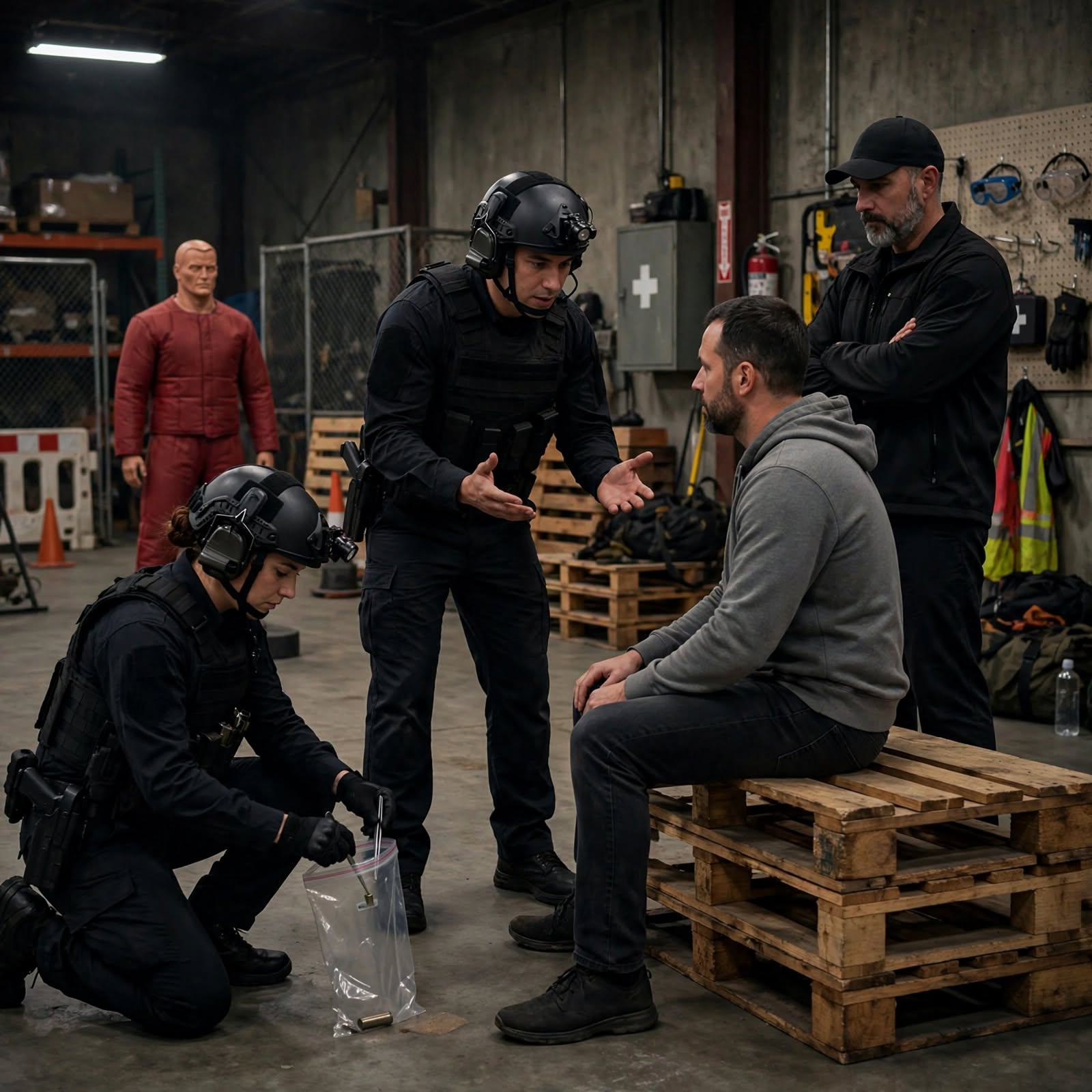
3. Prioritizing Tactical De-Escalation and Spatial Awareness
The primary objective of modern law enforcement training is resolving critical incidents at the lowest possible level of force. Scenario training is an effective method for teaching officers that physical confrontation is not inevitable.
- Verbal Tactics Under Duress: Trainees must actively listen, interpret behavioral cues, and apply crisis communication techniques to calm non-compliant, distressed, or emotionally disturbed individuals while managing unpredictable surroundings.
- Time, Distance, and Shielding Principles: Realistic simulations emphasize creating reactionary gaps, utilizing natural barriers for cover, and slowing down volatile incidents rather than rushing into close-quarters struggles.
- Recognizing Compliance and Immediate Disengagement: Scenarios challenge officers to instantly scale down their posture the moment a subject complies, reinforcing that force must cease the moment a threat is neutralized or yields.
4. Sharpening Threat Recognition and Shoot/Don’t-Shoot Judgement
Tragic field outcomes frequently stem from misidentifying everyday objects as weapons or failing to recognize concealed indicators of violence until it is too late.
- Distinguishing Threats from Harmless Items: Using non-lethal training munitions and advanced simulation systems, recruits face scenarios where suspects abruptly present cell phones, wallets, vehicle keys, or firearms, forcing split-second visual discernment.
- Target Discrimination in Crowded Settings: Scenarios teach officers to assess beyond the immediate subject, evaluating background risks, crossfire angles, and innocent bystander proximity before deploying any intermediate weapon or firearm.
- Ambush Awareness and Pre-Attack Cues: Trainees learn to identify non-verbal pre-attack indicators such as blading the body, scanning for escape paths, target glancing, and clenched fists, allowing them to adjust their stance before a physical attack begins.
5. After-Action Reviews: Turning Experience into Lasting Muscle Memory
The true value of scenario training occurs after the scenario ends. The structured after-action review (AAR) dissects every second of the simulation to foster accountability and self-evaluation.
- Video-Assisted Performance Analysis: High-definition playback allows recruits to view their own body language, reaction times, muzzle discipline, and verbal choices through an objective lens.
- Articulating Reasonable Perception: Officers practice articulating why they chose a specific action based on the facts known to them at the time, developing the vital skill of writing comprehensive, defensible incident reports.
- Peer Observation and Group Learning: Trainees observe fellow officers work through alternative solutions to identical problems, expanding their tactical repertoire without experiencing every scenario directly.
Train for Real-World Realities with Blue Training Academy
When an emergency unfolds, officers do not rise to the occasion; they sink to the level of their training. Equipping public safety personnel with realistic, scenario-based decision-making programs saves lives, prevents unlawful uses of force, and restores community trust.
Blue Training Academy provides advanced scenario immersion, defensive tactics workshops, and specialized law enforcement training programs led by seasoned police trainers and tactical operators dedicated to professional excellence.