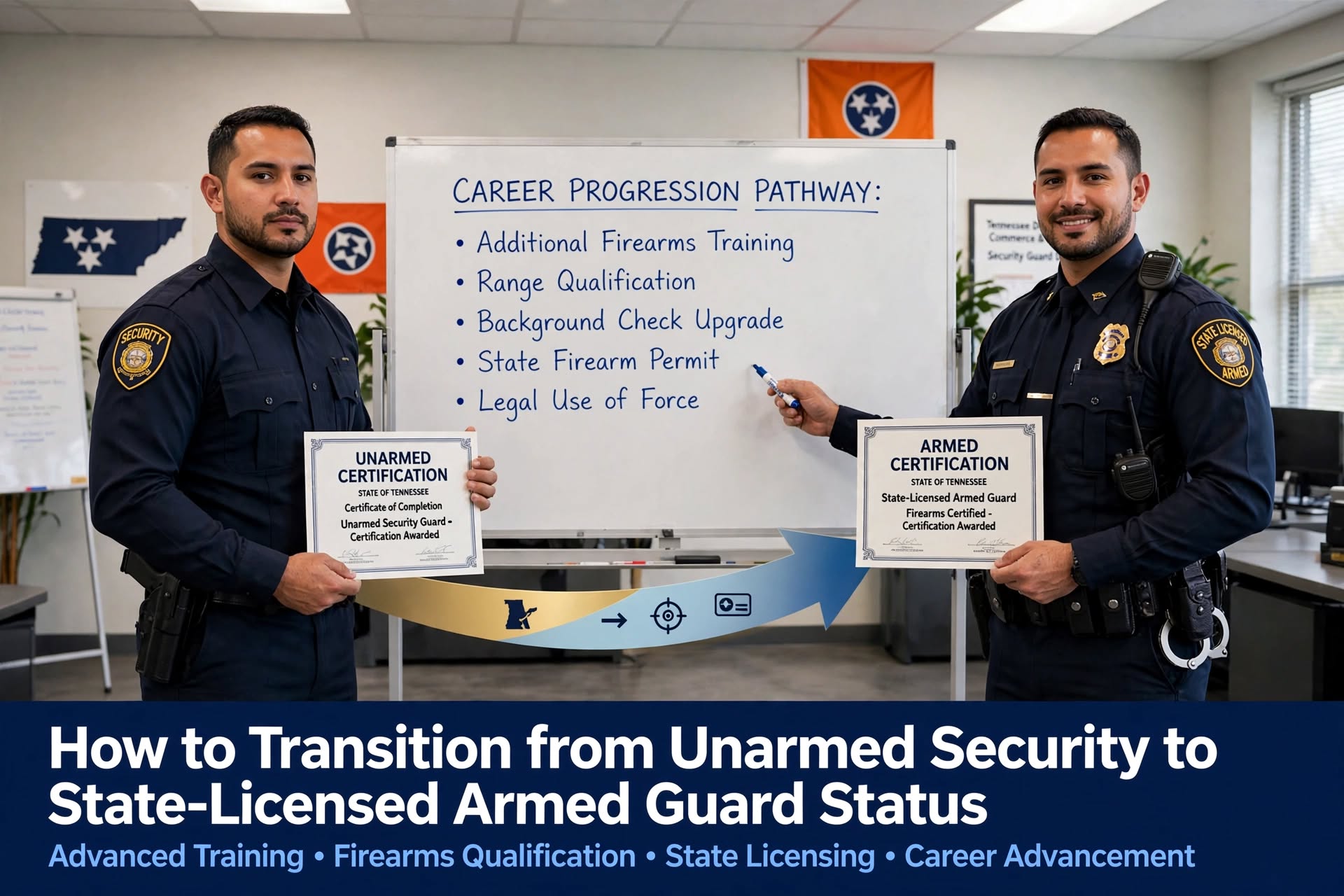
Working as an unarmed security officer provides valuable on-the-ground experience in observation, access control, visitor management, and dispute resolution. However, for security professionals looking to advance their careers, increase their earning potential, and qualify for high-responsibility assignments, transitioning to an armed guard status is the most effective next step.
Carrying a firearm on duty involves significantly higher legal responsibility, strict regulatory compliance, and a commitment to disciplined tactical judgment. Upgrading your license requires completing state-approved firearms instruction, passing live-fire range qualifications, and submitting formal state endorsements.
Blue Training Academy delivers comprehensive, state-certified armed security courses taught by experienced law enforcement and military veterans, giving officers the skills and legal clarity required to carry with confidence.
1. Verify Eligibility and Statutory Prerequisites
Before registering for armed guard training, candidates must ensure they meet baseline statutory requirements established by state licensing boards:
- Age Requirements: While unarmed guards can often register at 18, most states require armed security officers to be at least 21 years old.
- Active Unarmed Standing: Many jurisdictions require an active, in-good-standing unarmed guard registration or prerequisite foundational coursework before applying for an armed endorsement.
- Criminal Background Clearance: Armed licensing involves intensive state and federal (FBI) fingerprint background checks. Felony convictions, violent misdemeanors, and domestic violence offenses strictly disqualify candidates under state and federal law.
- Mental Fitness & Drug Screening: Applicants must demonstrate moral character, pass mandatory drug screenings, and meet mental fitness standards.
2. Complete Classroom Legal and Use-of-Force Instruction
Shooting proficiency is only one aspect of armed security. Understanding when, where, and how force may be legally applied is the most critical foundation of armed duty.
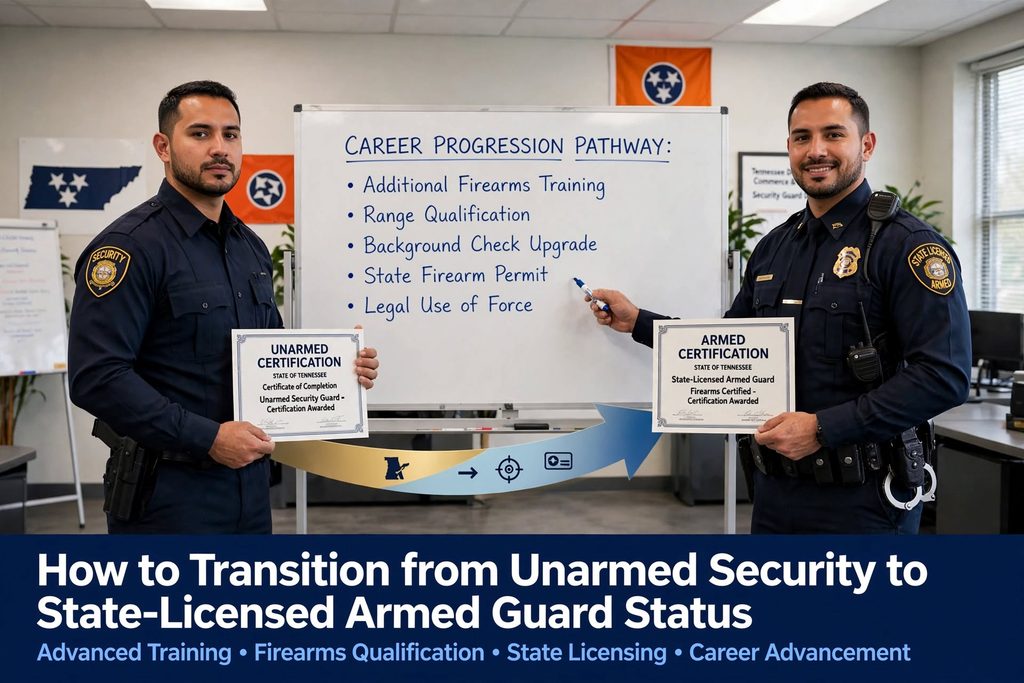
At Blue Training Academy, classroom modules cover:
- State Use-of-Force Statutes: Mastering the legal parameters of self-defense, defense of others, and the strict thresholds for deploying lethal force.
- Civil and Criminal Liability: Understanding the legal liabilities that apply to officers and security contractors during force encounters.
- De-Escalation as a Primary Tool: Learning verbal de-escalation techniques and spatial positioning to resolve hostile confrontations without drawing a weapon.
- Post-Incident Protocols: Managing scene preservation, weapon retention, rapid communication with local law enforcement, and detailed reporting.
3. Master Mechanical Firearms Safety and Handling
Before stepping onto a live-fire range, officers must develop strict firearm safety habits and muscle memory.
- The Four Universal Firearm Safety Rules: Practicing muzzle discipline, trigger finger placement, target awareness, and treating every weapon as loaded.
- Safe Draw and Holstering Mechanics: Drawing smoothly from level-two and level-three duty holsters without snagging or flagging bystanders.
- Stance and Recoil Management: Developing balanced defensive stances (such as modern isosceles) to maintain rapid sight alignment during multiple-shot engagements.
- Malfunction Clearances & Tactical Reloads: Diagnosing and clearing common stoppages (stovepipes, double feeds) and executing administrative, tactical, and speed reloads under time constraints.
4. Pass the State Live-Fire Range Qualification
To earn an armed endorsement, students must demonstrate marksmanship accuracy and safety under the direct supervision of a state-certified firearms instructor.
- Standardized Courses of Fire: Shooting from varying distances (typically 3, 7, and 15 yards) under strict time limits.
- Target Scoring Thresholds: Scoring above the mandated state minimum percentage (typically 70% to 80%) on silhouette targets.
- Weapon Verification: Qualifying with the specific caliber and firearm type (revolver or semi-automatic) that will be carried on duty.
5. Submit State Application and Endorsement Upgrades
Once range qualification is complete, your training records must be submitted to the state licensing authority:
- Obtain Training Certificates: Receive official documentation from Blue Training Academy verifying classroom hours and range qualification scores.
- File State Paperwork: Submit the armed upgrade application through the state licensing portal (such as Tennessee TDCI/CORE or Alabama licensing boards) along with required state filing fees.
- Complete Fingerprint Submission: Submit updated electronic fingerprints for armed-level processing.
- Receive Armed Credential: Once approved, your active armed security license allows you to carry your authorized weapon on client sites in accordance with post orders.
6. Maintain Ongoing Compliance and Recertification
Earning an armed security license is an ongoing commitment. Armed guards must maintain weapon proficiency and adhere to statutory renewal timelines:
- Annual Re-Qualification: Most states mandate annual or biennial range qualification and refresher legal training to maintain active armed status.
- Weapon Maintenance: Keeping duty gear, holsters, weapon lights, and firearms cleaned, inspected, and in operational condition.
- Advanced Skills Expansion: Continuing education in tactical trauma care (First Aid/CPR/Stop the Bleed), intermediate weapons (baton, OC spray, handcuffs), and executive protection.
Upgrade Your Security Career with Blue Training Academy
Transitioning to armed security status opens new career pathways in cash logistics, critical infrastructure, corporate facilities, and executive protection. Quality instruction ensures you operate safely, professionally, and within the full boundaries of the law.
Blue Training Academy provides state-approved armed security certification courses led by professional instructors dedicated to student success and operational excellence.