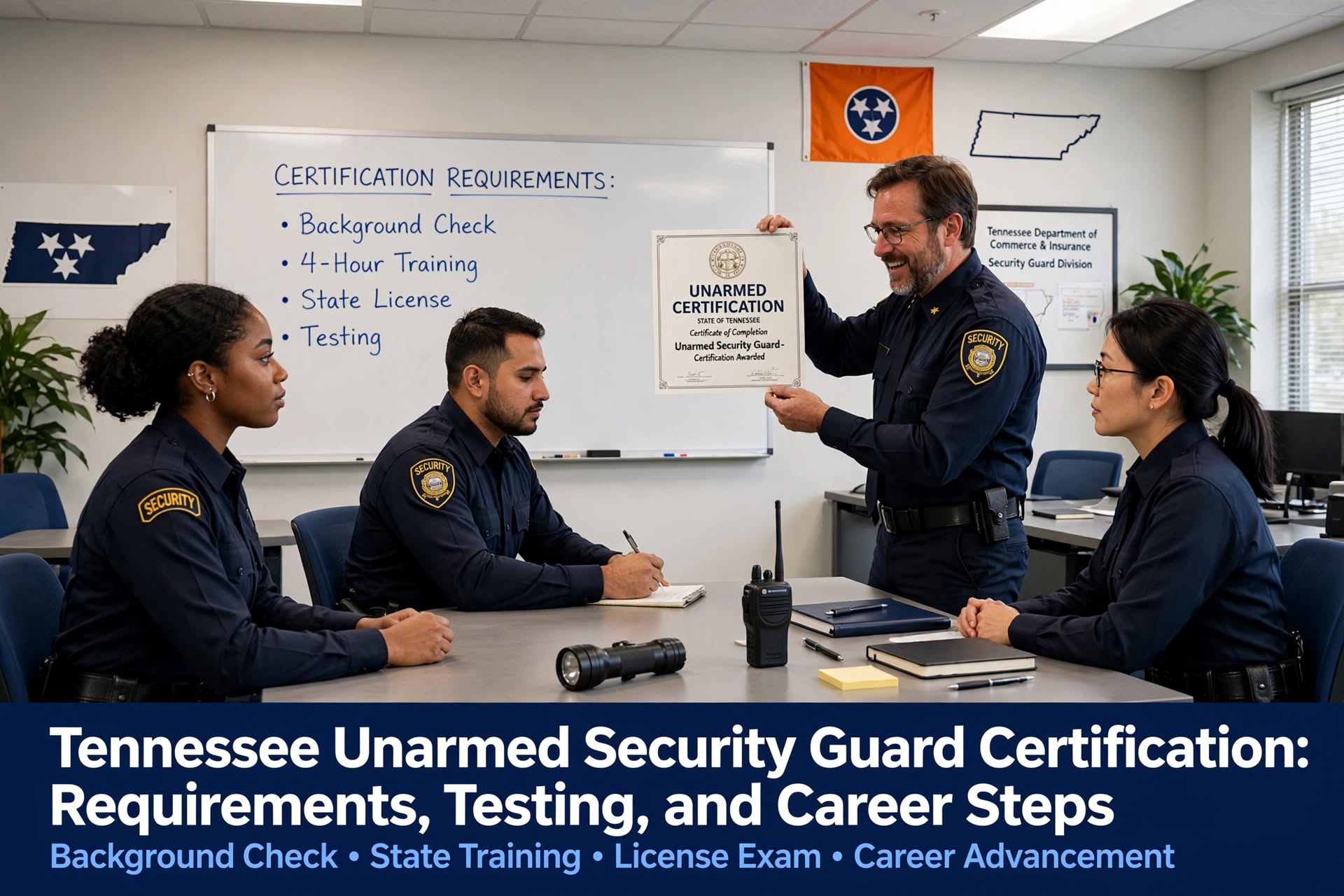
The private security industry across Tennessee is expanding rapidly, creating consistent demand for licensed security officers in corporate offices, distribution centers, residential communities, and retail venues. In Tennessee, working as a security officer without state authorization is prohibited by law. All unarmed guards must be formally licensed through the Tennessee Department of Commerce and Insurance (TDCI) Private Protective Services division.
Obtaining your state certification is a direct, accessible process when you follow the required statutory steps. Blue Training Academy provides state-approved instruction designed to guide candidates through mandatory coursework, exam preparation, and license application protocols.
State Eligibility and Licensing Requirements
Before registering for coursework or submitting state applications, candidates must satisfy the foundational qualifications established by Tennessee law:
- Age Requirement: Applicants must be at least 18 years old for an unarmed registration.
- Citizenship Status: You must be a United States citizen or a legally registered resident alien.
- Criminal Background Clearance: Applicants must complete electronic fingerprinting through IdentoGO for state (TBI) and federal (FBI) background investigations.
- Statutory Disqualification Standards: Candidates must have no felony convictions or disqualifying misdemeanor convictions (including violent crimes, weapons offenses, theft, or narcotics distribution) within five years preceding application.
- Moral Character and Mental Fitness: Candidates must demonstrate professional competence and freedom from illicit drug or alcohol dependence.
Mandatory 4-Hour General Training Curriculum
Tennessee mandates that all unarmed candidates complete a certified 4-hour basic training course taught by a state-approved instructor. This curriculum builds the core legal and practical foundation necessary for field operations.
The curriculum at Blue Training Academy covers four required subject areas:
- Orientation and Professional Conduct (1 Hour): Overview of the private security industry, professional ethics, standard uniform standards, attendance policies, and client expectations.
- Legal Powers and Limitations of Security Officers (1 Hour): Understanding the crucial legal distinction between private security personnel and sworn law enforcement, citizen arrest limitations, search and seizure laws, and property owner rights.
- Emergency Procedures and Critical Incident Response (1 Hour): Protocols for managing building evacuations, fire alarms, medical emergencies, active hazards, and collaborating with first responders.
- General Patrol Duties and Observation Techniques (1 Hour): Mastering foot and vehicle patrol methods, field observation principles, radio protocol, and drafting accurate Daily Activity Reports (DARs).
Testing and Examination Standards
Upon completing the four-hour instructional blocks, students must demonstrate subject mastery through the state-mandated written exam:
- Exam Structure: The test consists of multiple-choice and true/false questions evaluating legal boundaries, emergency protocols, and operational safety.
- Passing Threshold: A minimum score of 70% is required to earn your official training certificate.
- Certificate of Completion: Once passed, candidates receive an official state training completion document that must be submitted with their registration application.
Step-by-Step Licensing and Application Process
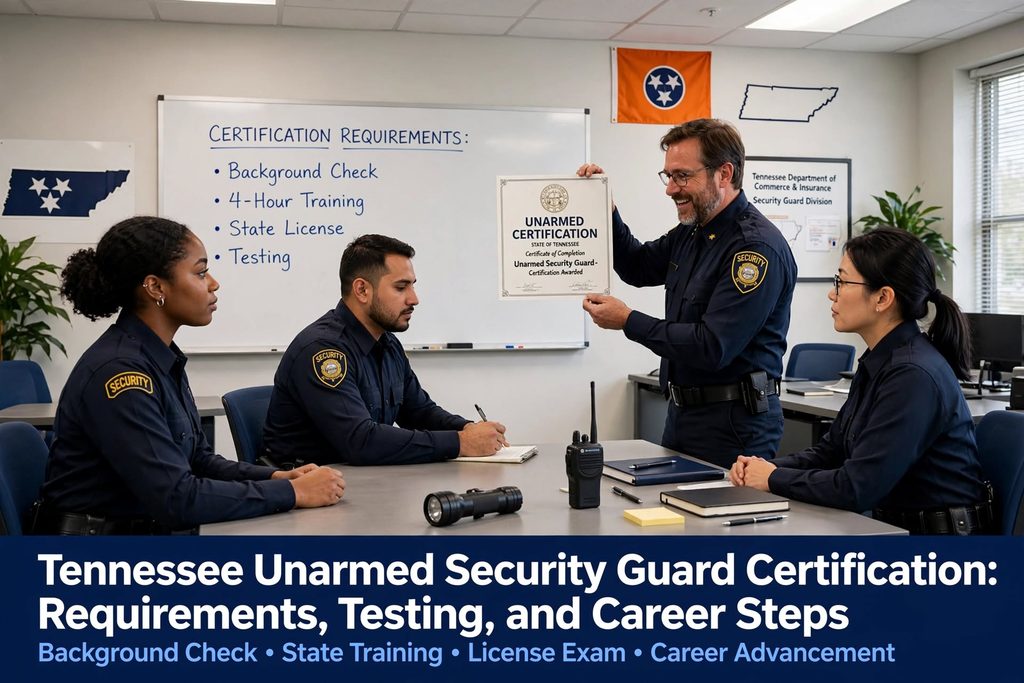
Once you finish your training, follow these structured steps to secure your active license:
- Step 1: Schedule Digital Fingerprinting: Book an electronic fingerprinting appointment through IdentoGO using the Tennessee Private Protective Services regulatory ORI code.
- Step 2: Create a Tennessee CORE Account: Access the state’s Comprehensive Online Regulatory Enforcement (CORE) portal and register an individual profile.
- Step 3: Submit Documentation: Upload your government photo ID, passport-style photograph, and your training completion certificate from Blue Training Academy.
- Step 4: Remit State Application Fees: Pay the state registration fee electronically via the CORE portal.
- Step 5: Utilize the Pending Work Authorization Grace Period: Under Tennessee regulations, unarmed applicants who have submitted their complete application, fees, and training proof may work under a conditional 75-business-day grace period while TDCI processes their official credential.
Career Steps: Advancing Beyond the Unarmed Guard Card
An unarmed license serves as an entry point into protective services. Once established, officers can expand their credentials to qualify for specialized roles and higher-paying security assignments:
- Less-Lethal Certifications: Expand your defensive toolkit by completing state-approved endorsements in expandable baton, tactical handcuffing, and chemical spray (OC).
- Hospitality and Venue Endorsements: Under Tennessee law, guards working at venues serving alcohol on-premises must complete specialized de-escalation, safe restraint, CPR, and first-aid training.
- Transition to Armed Guard Status: Upgrade to an armed guard license by completing the additional classroom instruction, legal use-of-force modules, and range qualification courses.
- Field Supervisory Roles: Leverage proven on-site experience, precise report writing, and leadership skills to advance into shift supervisor, site manager, and field training officer positions.
Start Your Security Career with Blue Training Academy
Launching your career in Tennessee private security begins with quality training that instills confidence, operational readiness, and legal clarity.
Ready to review the course? Visit Tennessee Unarmed Security Training for the curriculum, current price, enrollment link, and certificate steps. Complete the course and required assessments, then follow the emailed verification instructions. Certificate issuance requires identity review and approval. For employees, use our team training inquiry form.