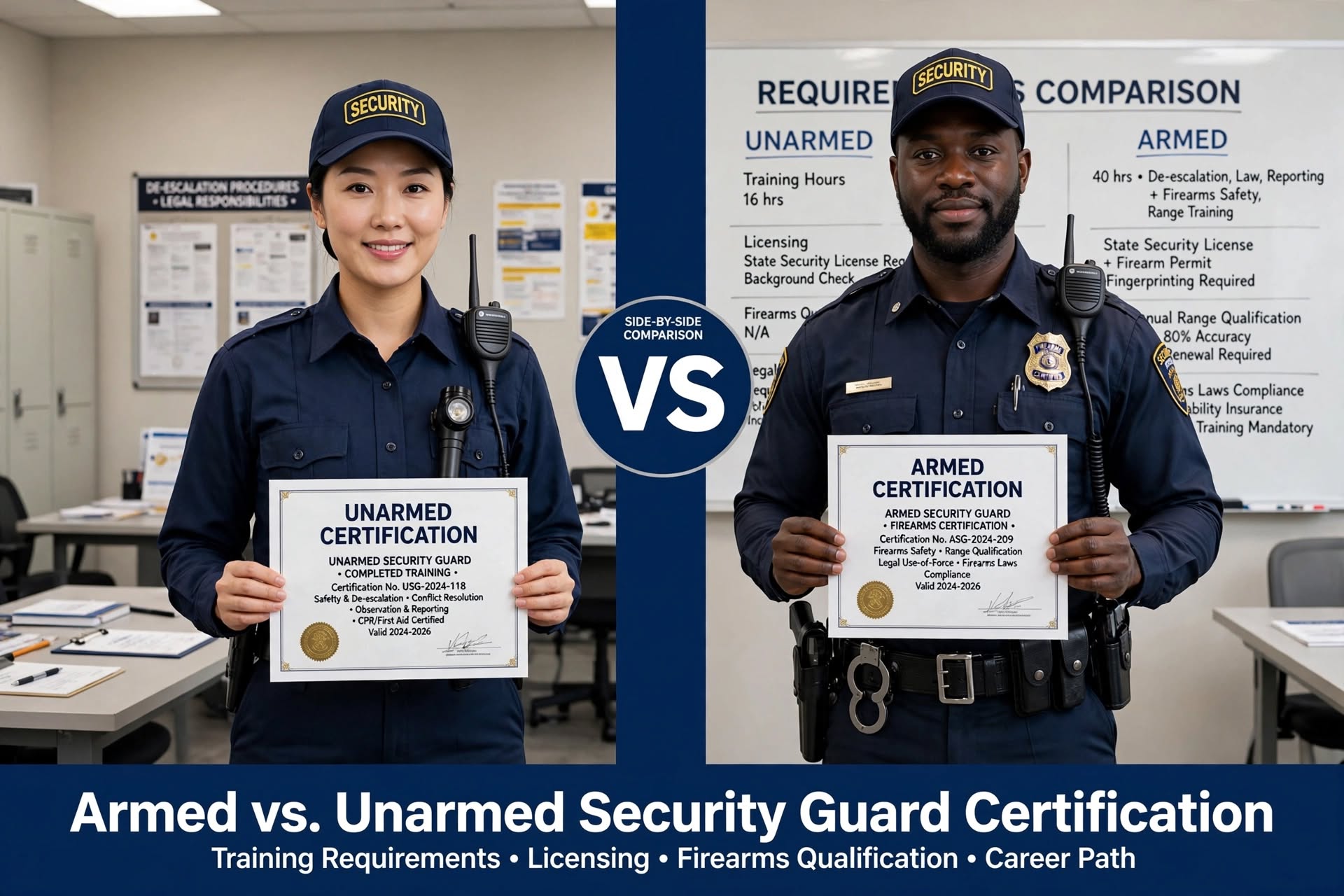
The private security industry continues to expand rapidly, offering reliable career opportunities across commercial, industrial, residential, and corporate sectors. For anyone looking to enter or advance in the field, one of the most critical early decisions is choosing between an unarmed or armed security guard certification.
While both roles share foundational responsibilities such as maintaining vigilance, documenting incidents, and protecting property, they involve vastly different levels of legal liability, training requirements, work environments, and compensation.
Blue Training Academy offers specialized, state-approved training programs designed to equip aspiring officers and seasoned professionals with the exact credentials needed to excel in either career path.
Understanding the Unarmed Security Career Path
An unarmed security guard certification serves as the primary entry point into the security industry. Unarmed officers focus heavily on proactive deterrence, access control, customer service, and observation.
Core Duties & Work Environments
Unarmed officers typically secure low-to-medium risk environments where a visible, professional, yet approachable presence is required:
- Corporate office lobbies and reception desks.
- Retail shopping centers and lifestyle plazas.
- Apartment communities, gated HOAs, and residential complexes.
- Educational institutions, healthcare facilities, and public venues.
Certification & Training Requirements
- Fast Entry: Unarmed licensing generally requires fewer classroom hours, focusing on legal authority, report writing, emergency response basics, and verbal de-escalation.
- Accessible Prerequisites: Most states set the minimum age requirement at 18 with standard background check clearances.
- Low Upfront Investment: Training fees and equipment expenses are minimal, allowing officers to get certified and start working quickly.
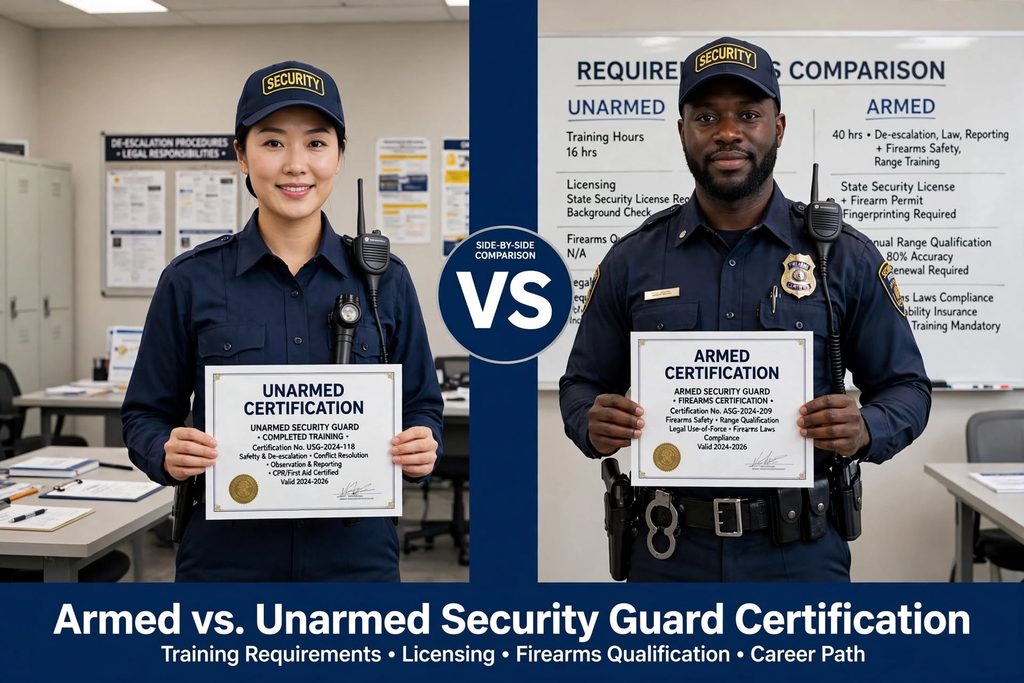
Understanding the Armed Security Career Path
Armed security certification authorizes officers to carry a firearm while on duty. Because carrying a lethal weapon introduces substantial legal responsibility and physical risk, armed guards are held to rigorous operational and regulatory standards.
Core Duties & Work Environments
Armed officers are stationed at high-liability, high-risk, or high-value locations where immediate threat response capabilities are required:
- Financial institutions and banks.
- Armored transport and cash management logistics.
- Government facilities, critical infrastructure, and utilities.
- High-value retail (such as jewelry stores and luxury goods).
- Executive protection details and high-risk commercial facilities.
Certification & Training Requirements
- Advanced Firearms Qualification: Includes extensive range qualification, marksmanship, weapon handling, malfunction clearing, and holster draw mechanics.
- Use-of-Force Legal Frameworks: In-depth study of self-defense statutes, lethal force thresholds, civil liability, and crisis decision-making.
- Stricter Prerequisites: Most jurisdictions require officers to be at least 21 years old and undergo comprehensive criminal history screenings and mental fitness evaluations.
Comparing the Key Factors: How to Choose
To determine which certification aligns best with your professional goals, weigh these critical factors:
- Earning Potential: Armed positions generally command higher hourly wages and salaries than unarmed roles due to the specialized qualifications and liability involved.
- Risk & Liability Exposure: Carrying a firearm demands heightened situational awareness and strict accountability. A split-second decision can have life-altering legal and physical consequences.
- Physical & Equipment Costs: Armed officers must invest in reliable firearms, duty holsters, body armor, and regular ammunition costs for annual range re-qualifications.
- Customer Interaction vs. Threat Deterrence: Unarmed positions emphasize de-escalation, public interaction, and visitor management, whereas armed assignments prioritize high-readiness deterrence and immediate response.
The Strategic Path: Transitioning from Unarmed to Armed
You do not have to make a permanent choice on day one. Many successful security professionals begin by obtaining their unarmed license, working in diverse environments, mastering access control, and sharpening their communication skills.
Once you establish a solid track record, upgrading to an armed security certification opens doors to supervisory roles, critical infrastructure defense, and executive protection assignments.
Launch or Upgrade Your Security Career with Blue Training Academy
Whether you are starting from scratch or ready to earn your armed firearms credentials, proper training from industry-experienced instructors makes all the difference.
Blue Training Academy delivers hands-on, state-certified instruction designed to prepare officers for real-world scenarios, legal compliance, and long-term career advancement.