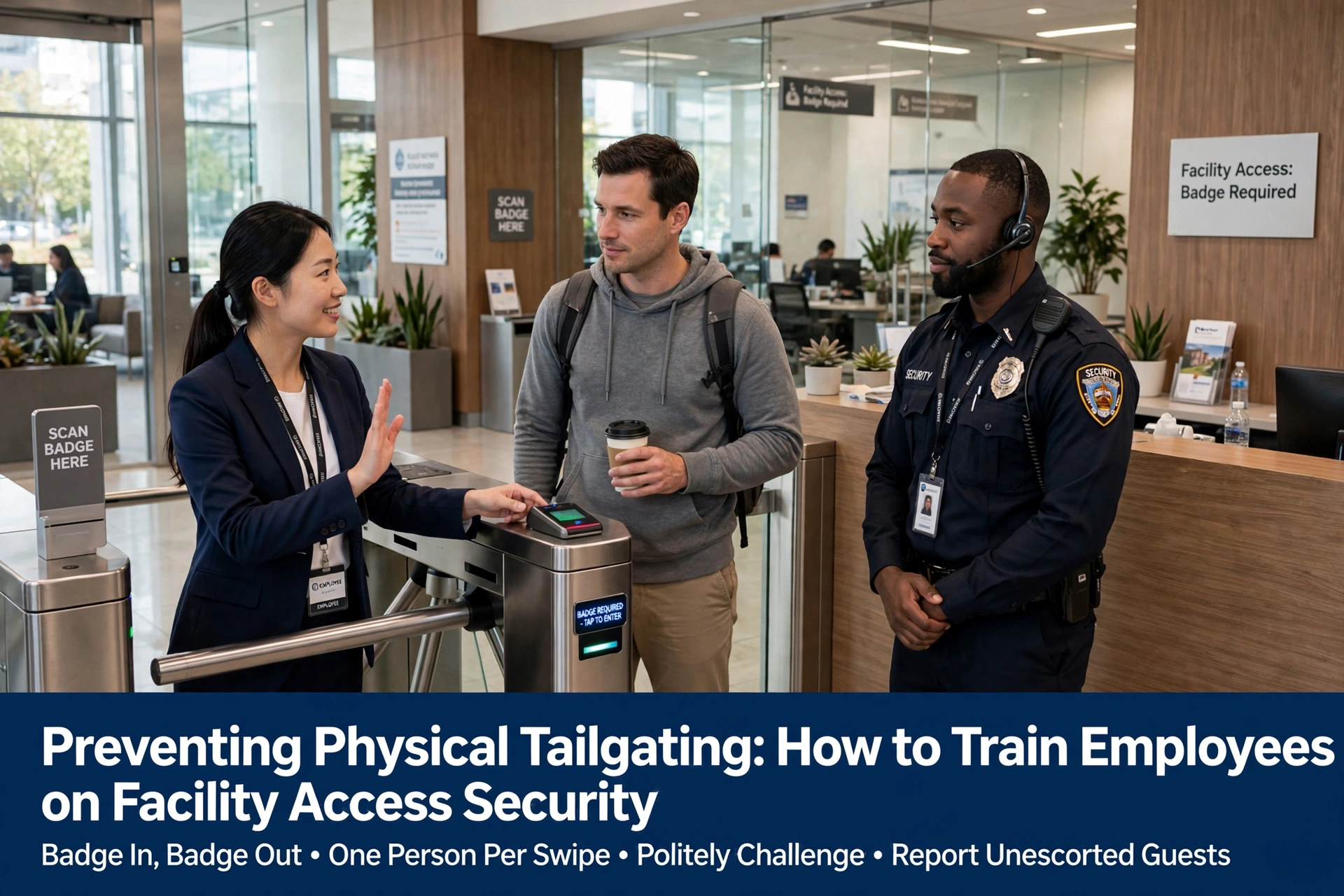
Organizations invest thousands of dollars into electronic access control systems, magnetic door locks, biometric scanners, and smart credential cards. Yet, even the most sophisticated electronic defense can be bypassed in a single second by an unauthorized person simply catching an open door.
This vulnerability is known as physical tailgating (or piggybacking). It occurs when an unauthorized individual follows closely behind an authorized employee to slip through a secured door, turnstile, or gate without presenting their own credentials.
Unlike cyber threats that breach firewalls through malicious code, tailgating exploits human psychology specifically: our instinct to be polite, helpful, and courteous.
To eliminate this physical security risk, businesses must train their workforce to view access control not just as a piece of hardware, but as an active shared responsibility. Blue Training Academy works with organizations to establish strong physical security awareness programs. Here is how companies can effectively train employees to prevent tailgating and maintain airtight facility access security.
Understanding Why Tailgating Is Such a Common Threat
Tailgating remains one of the easiest and most common social engineering tactics used by industrial spies, disgruntled former employees, thieves, and trespassers.
The primary reasons tailgating succeeds include:
- The Politeness Trap: Society conditions people to hold doors open for anyone walking directly behind them. Closing a door in someone’s face feels rude, awkward, and uncomfortable.
- The Disguise of Authority or Urgency: Intruders frequently pose as delivery drivers carrying heavy packages, utility technicians in high-visibility vests, or rushing executives on the phone, leveraging visual cues to discourage questioning.
- Complacency in High-Volume Traffic: During peak morning arrivals, lunch rushes, or end-of-shift departures, workers often move through secured turnstiles in large groups without requiring individual badge scans.
1. Reframe Security as Professionalism, Not Rudeness
The biggest hurdle in eliminating tailgating is overcoming employee hesitation. Workers must understand that enforcing badge access is an act of care that protects everyone inside the building.
- Establish a “Badge for Entry, Every Time” Rule: Make it standard policy that every individual from entry-level interns to C-suite executives must personally scan their badge to pass through any access-controlled perimeter.
- Normalize Closing the Door: Train staff to let doors close and latch completely behind them rather than catching or propping them open.
- Remove the Social Stigma: Emphasize during company-wide briefings that asking someone to badge in is not an accusation; it is the established corporate standard.
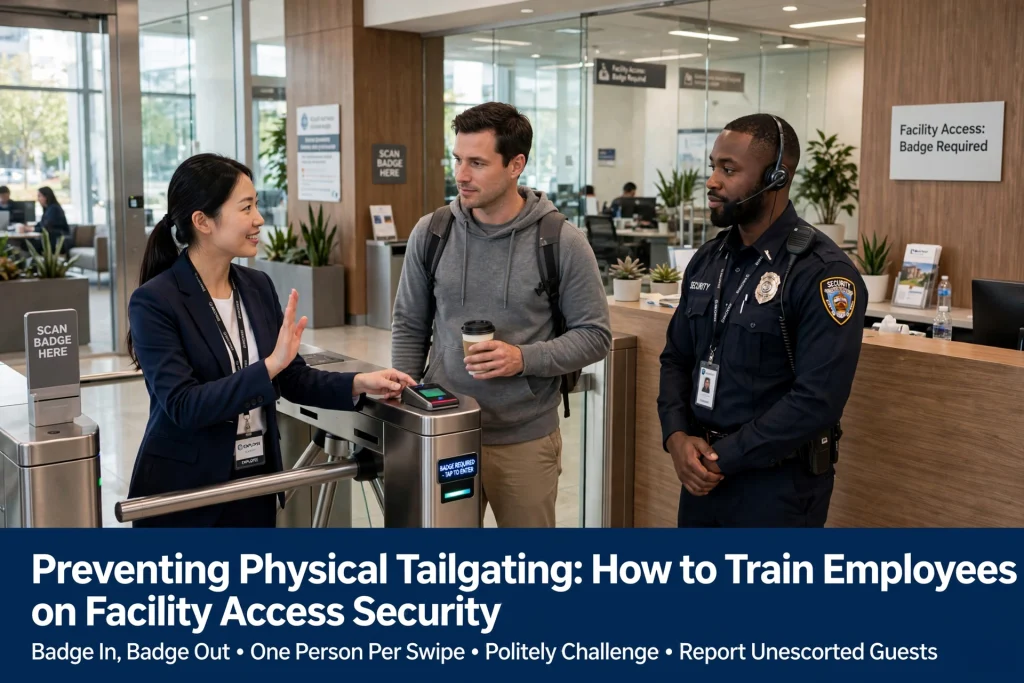
2. Teach Practical, Non-Confrontational Response Scripts
Employees often freeze when confronted with a potential tailgater because they do not know what to say without sounding aggressive. Providing simple, polite scripts removes friction and empowers staff to take immediate action.
Effective verbal techniques include:
- The “Company Policy” Approach: “Hi there! Our security policy requires everyone to swipe their own badge. Could you scan yours really quick?”
- The “Visitor Assistance” Redirect: “Good morning! If you don’t have an active badge today, I’d be happy to walk you over to the front reception desk to get signed in.”
- The Delivery & Vendor Protocol: “Thank you for the delivery! Please hold on right here while I notify reception to let you in and accept the drop-off.”
3. Train Employees to Spot Common Infiltration Scenarios
Physical social engineers rely on predictable behavioral patterns. Training employees to recognize these tactics enables them to spot suspicious attempts immediately.
Key tactics to cover during training include:
- The “Full Hands” Trick: Carrying coffee trays, heavy boxes, or equipment to force an employee to hold the door open out of chivalry.
- The “Distracted Professional” Act: Pretending to be deep in an urgent phone call while walking confidently behind an authorized worker.
- The “Forgotten Badge” Story: Claiming to work in another department or floor and asking to be let in just this once.
4. Reinforce Reporting Channels for Access Anomalies
If an employee encounters an unbadged individual who refuses to scan their credentials or becomes hostile when questioned, staff should never engage in physical confrontation.
- Avoid Escalation: Instruct employees to step back, avoid blocking someone aggressively, and maintain a safe physical distance.
- Note Key Identifiers: Observe physical descriptors, clothing, and direction of travel.
- Immediate Alerting: Report the unauthorized entry immediately to on-site security, facility management, or the front desk dispatch.
5. Conduct Regular Access Audits and Scenario Refreshers
Access security is not a one-time onboarding video. Without regular reinforcement, employee diligence naturally slips over time.
- Periodic Security Audits: Conduct controlled, friendly security sweeps to test how consistently doors latch and whether unbadged visitors are challenged.
- Refresher Briefings: Review access protocols annually or whenever physical security infrastructure is upgraded.
- Signage Reminders: Place clear, branded signage at all badge-access doors reminding personnel that individual badge scans are mandatory.
Strengthen Your Facility Security with Blue Training Academy
A secure facility starts with an informed and confident workforce. By equipping your staff with practical awareness, non-confrontational de-escalation skills, and clear protocols, you transform your employees into an active frontline defense against unauthorized access.
Blue Training Academy delivers comprehensive corporate physical security training, access control workshops, and employee safety seminars designed to protect your assets, facility, and team.
Upgrade your organization’s physical security protocols today. Schedule a customized corporate training session with Blue Training Academy:
- Website: bluetrainingacademy.com